
When I was touring Poland I was amazed that it was occupied or erased from the earth so often or so long. The Swedes took it for 600 years. One of the reasons is that like Latvia it is too close to the power houses of Russia and Germany. Basically the same thing happened here. Peter the Great took it in 1710 and Russia held onto it until the end of the first world war. The Latvians were elated to get it back and they tried Democracy first but as is often the case they needed some practice going directly to Democracy from Monarchy. So for awhile they had a benevolent dictator like Ataturk in Turkey.
However, the Russian-German non-aggression pact meant that the Russians felt comfortable “annexing” Latvia once again in 1934. I bet the Ukraine is watching this. Russia occupied Latvia until the Germans went against the pact and invaded Latvia in 194`1.
After the war the Latvians thought they would get their country back especially with the support of the UK and USA. Alas we were not paying attention so Russia marched in and took it back. But the Russia post-war, now the Soviets, and the earlier Russians were a different sort.
They established a government of terror, subterfuge and paranoia. To keep the citizenry in check they created a secret police known here as the Cheka (like the STASI in East Germany. Rent the movie The Lives of Others for a chilling and human representation of this ). The Cheka operated out of a special building created by the most famous of the Latvian Art Nouveau architects whom they accused of anti-communist ideas and promptly shot.
During these years the Cheka worked diligently to instill terror in the hearts of its citizens and to create a climate of total mistrust. They routinely rounded up people and took them into custody in the Corner House as it was known which was fitted with a gate so that trucks could unload people without others seeing them in the inside courtyard. Everything was dark and ominous. Prisoners were taken immediately into this lift but they didn’t know why they were there or with what they would be accused. Since no one from the outside world knew they were even picked up the shroud of secrecy prevented them from contacting their loved ones or even questioning their incarceration.
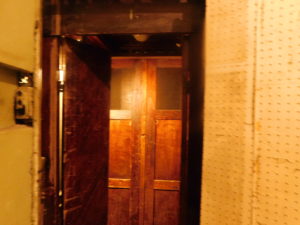
If their friends or relatives wanted to know what happened to them or if they were even in the Corner House they had to leave a note in the outside mailbox. This same box was used to denounce anyone for non-communist leanings or just to get rid of someone you didn’t like. The authorities seldom even responded to requests for information.
From the elevator the prisoners were taken into the office where they were stripped–they never regained their clothes–and their possessions were inventoried and stored in these files.
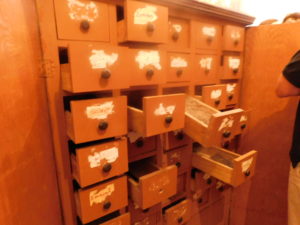
The idea of course was to break down any resistance. The Soviets rounded up all students and artists and dissidents who they labelled “enemies of the state.” No trials followed. After interrogation and the signing of confessions–which always happened. They were taken into the courtyard one after another. A car engine was turned on to block out the noise, They were escorted into a holding room where the papers were signed and then taken into the next room and shot in the back of the head. There was a shute already prepared into which the body was lifted and it just moved down a tube into the back of the truck that would take it to a mass grave outside of town. It was a very efficient system because no prisoner ever escaped. Sometimes they were dispatched to other sites for long term hard labor or to be executed.
I didn’t take a picture of the cells because you have all seen the movies. They look remarkably like depicted. The exercise yard is about ten by ten and 30 prisoners wouldbe walking in a circle for 10 minutes a day. Since there was no reason to treat them well at all they were simply given three bowls of broth a day with a piece of bread until it was their time to die.
When the Soviet Union collapsed in 1991, Latvia like all of the other Soviet Satellite states demanded freedom. Miraculously all of the files about murdered prisoners disappeared with the exception of about 30 which remained at the Corner House. The Soviet guards got out as soon as possible and disappeared into society, in most cases without a trace.
One harrowing story actually followed the end of WWII. As the UK and USA were preparing the trials at Nuremberg the Soviets prepared their own trials which were military trials and were designed to show the new world order with the
Soviets firmly in control. Their first trial was for 4 generals accused of crimes against humanity. Unfortunately one died in his cell and the Soviets felt that just hanging three would look bad so they rounded up a lone German and hung him as the fourth.
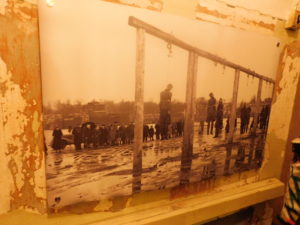
Here is the exercise yard.
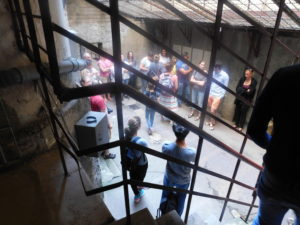
I was interested in how people felt now. There are many Soviets living in Riga and they are, in a lot of cases, rich and own the best properties. The last prisoner actually got out in 1991 as the guards were leaving. So there are many people who remember those times. How do they interact now with Russians? I was told that it really is a matter of generation. The older Latvians dont have much to do with the Russians unless they have to. The younger ones share an optomism about their lives and as one told me “we just hope it never happens again.” As someone who has never experienced being on the wrong end of an occupation I was actually amazed that they could be so cavalier but one guy said “What is the choice? We have to learn to live together and move forward.”
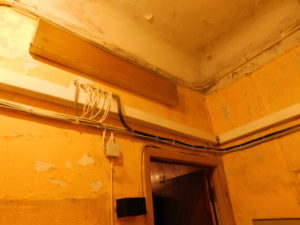
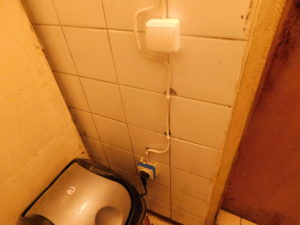
In keeping with my need to document electricity flows around the world I leave you with two pictures. The first is below the ground where the prisoners would have been kept. The second is the “modern” electricity in the bathroom. Do not approach this on your own.
There was a chilling artistic exhibition in Buenos Aires which I had the privilege to see on one of my travels. It was all about bicycles. There were paintings of bicycles on the sides of buildings where they might have been chained in reality. There were photos of abandonded bicycles. There were flags of wood cut and batiked and tie-dyed fabrics all depicting bicycles that the viewer had to walk through when entering the exhibition. These bicycles were symbols of the “disaperacidos”–the disappeared. Those who were taken by the state much like the Cheka and simply were never heard from again. Their bicycles were often found and this is how their friends and families knew they had been taken. No one ever confirmed the abductions. Some were shot. Others in a more horrific method of killing were taken in a plane and simply thrown out into the ocean. All for a short burst of power that will soon dissipate anyway.