
I really wanted to understand Gallipoli just to see in this modern age (1914) 500,000 people could lose their lives. It was worse in the Somme but trench warfare like that was just wholesale slaughter. This was something else.
The tour took 4 hours and recounted all of the bad decisions of Churchill, Kitchener and Hamilton. The objective was to take the Dardanelles and use them as a supply route to Russia. Since Turkey was considered “the sick child of Europe” the British believed the battle would be quick and decisive. The idea was to take the two fortifications guarding the Dardanelles and move on to Constantinople. Even when two battleships and two smaller ships were mined in rapid succession, the British still maintained their stupid plan.
You can easily read about this battle so no details here. Just wanted to get the feeling, to see it, to try to understand that a battle expected to take a week took 9 months. I also found it interesting that I was on the soil of the “victor,” but was hearing the story of the loss of Allied lives. Even Normandy which is wrenching is on the soil of the victor, we hear nothing from the German perspective.
So we went to all the sites where the battle took place and the guide explained the decisions and their consequences. Then we saw the graves.
The graves had names but many started with “believed to be the resting place of . . .”, Some had religious sayings afterwards because the Turks have tried to find the families of those whom they had identified to see if they wanted anything added to the stones. All of the Christians are buried together from Australia, New Zealand, England, France. The Muslims have their own space.
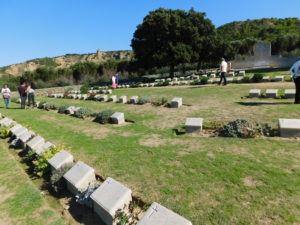
The mood is well established in this place.
The most interesting part of the day was a granite wall with an inscription from Ataturk, the founder of the Turkish Republic. I couldn’t get the picture because of the shadows but it is too important not to insert here.

I don’t think I have ever read anything as poignant and empathic as this message to the fallen and their mothers. I knew he was an unusual man. He was a soldier and he commanded a whole regiment at this battle but he rose to become the first ruler of Turkey. He took what was left of the Ottoman empire at the end of WWI and made it into a modern state. Think about that, while the rest of the Muslim world stayed backward he did this.
Although Turkey was now almost homogeneously Muslim, Mustafa Kemal deposed the caliph, the theoretical successor to the prophet Muhammad and spiritual leader of the worldwide Muslim community. He also closed all religious courts and schools, prohibited the wearing of headscarves among public sector employees, abolished the ministry of canon law and pious foundations, lifted a ban on alcohol, adopted the Gregorian calendar in place of the Islamic calendar, made Sunday a day of rest instead of Friday, changed the Turkish alphabet from Arabic letters to Roman ones, mandated that the call to prayer be in Turkish rather than Arabic and even forbade the wearing of fez hats.
Mustafa Kemal’s government espoused industrialization and adopted new law codes based on European models. “The civilized world is far ahead of us,” he told an audience in October 1926. “We have no choice but to catch up.” Eight years later, he required all Turks to choose a surname, selecting Atatürk (literally Father Turk) as his own. By that time, Atatürk’s government had joined the League of Nations, improved literacy rates and given women the right to vote, though in practice he essentially imposed single-party rule. He also closed opposition newspapers, suppressed leftist workers’ organizations and bottled up any attempts at Kurdish autonomy.