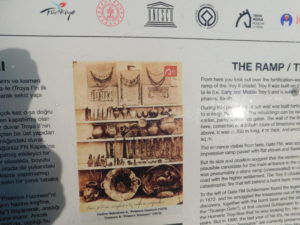
For some reason Troy has always been on my Bucket List. Not because of the telenovela of Helen and Paris but because of the discovery. I was not disappointed. As you know Heinrich Schliemann was obsessed with Troy and used a fortune inherited by his brother’s exploits in the California Gold Rush to locate and essentially ransack Troy. While we all love The Paris-Helen-Menelaus triangle the real reason was pure greed. Troy was at a favored position and could extract tithes from all of the ships seeking entrance to Constantinople. The city was awash with money. The Greeks, being just on the other side of the Aegean, simply wanted it. It took 10 years to gain it but they eventually prevailed. The horse? No one really knows. It was a formidable walled city of about 6,000 inhabitants at the time and maybe there was a horse, or maybe not.
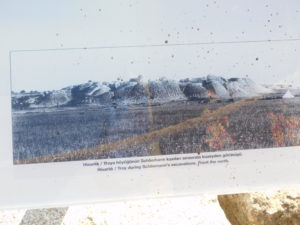
When Schliemann found it he was actually finding what is called Troy VI. (of IX) Over the centuries earlier versions of the city were destroyed by fire or earthquake. His initial view of the city was a grass-covered mound much like the archaeologists in Mexico view potential pyramids. But his excavations eventually uncovered the modern Troy VI as well as vestiges of past versions of the city.
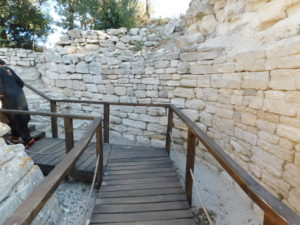
The site itself is really well laid out for visitors. There are walkways and viewing platforms and all are labeled with their version (Troy I, Troy III etc.). You can see what he saw as he excavated. This is an entrance to the city which includes two features: a narrow passage, thus prohibiting large armies from entering; a sharp angle–no battering rams. This is the kind of planning that amazes me. Maybe because I would never have thought of it, but it is so simple and so effective.
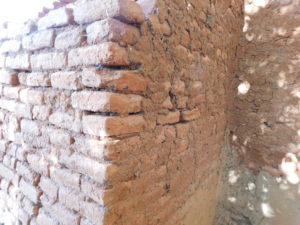
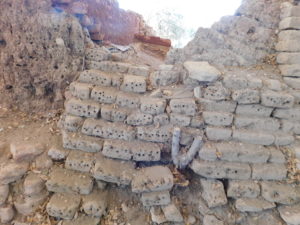
The later walls were made of mud and then covered with cow dung to keep out insects and to preserve the bricks.
Earliest walls were just stacked stones acquired from the two river beds are the forest.
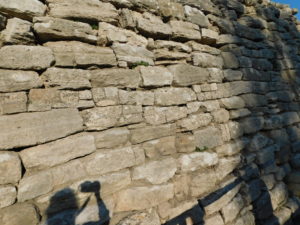
Since we are talking about structures that are around 4000 years old it took some time to learn to make bricks. The workers knew that the bricks should withstand earthquakes so they didn’t stack them but rather overlapped small angles so that they would be stronger.
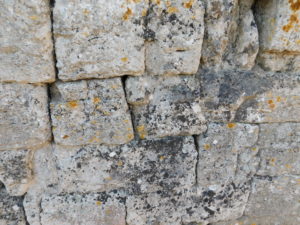
The earliest walls show bee and insect attacks
Schliemann believed that there was great treasure to be had and he was right. As such a rich city, Troy extracted anything of value from those who wanted to pass. The king did not hide the treasure in his house and when Schliemann found the house he was disappointed. The story goes that he saw something shiny in the garden and paid off the workers for the day. Throughout the night he and his wife dug up the garden and found more than 8,000 items. He, of course, stole them. After the War the Russians took them from the Germans and now they are in Pushkin Museum. I don’t know why they aren’t in Turkey. Follow the money